Making the Right Water Heater Choice for Your Home on the Palos Verdes Peninsula
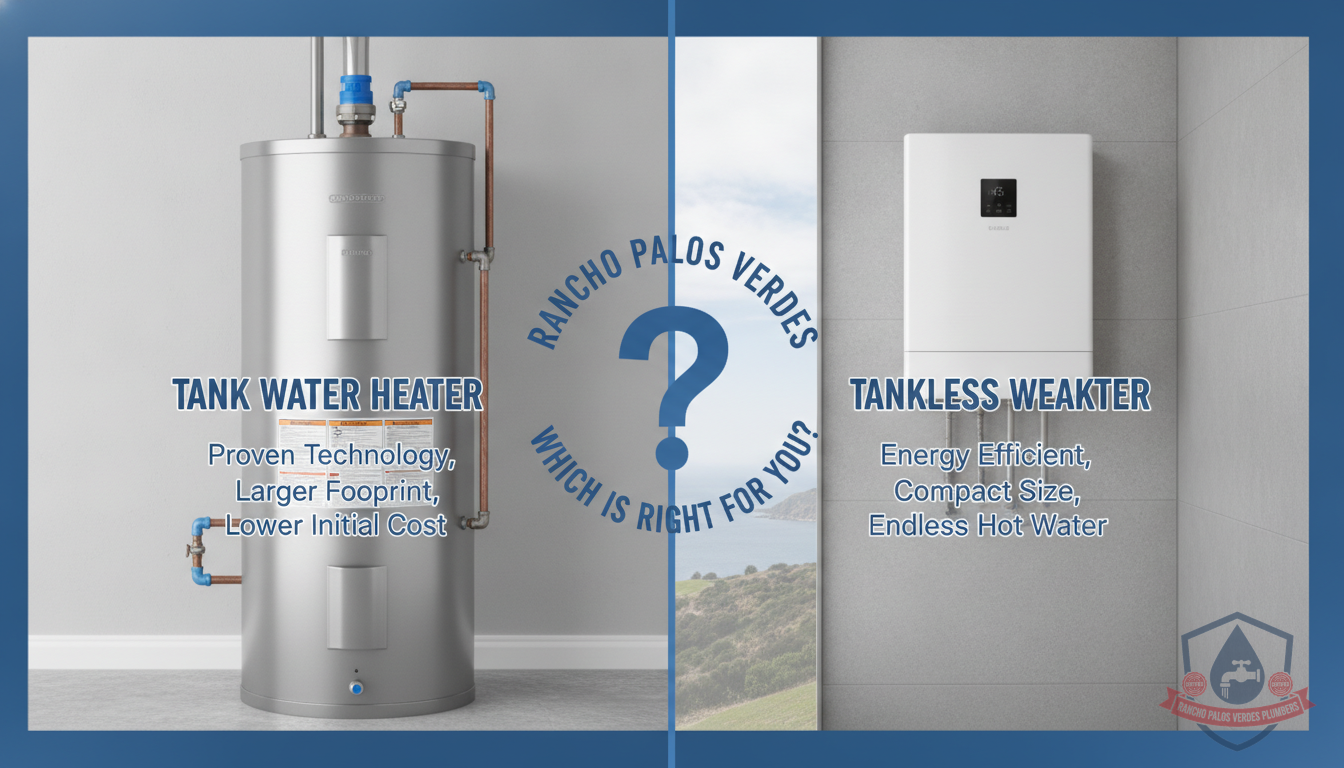
When a water heater reaches the end of its service life — or when you move into a home and discover the unit is already aging — homeowners face a choice that affects daily comfort, monthly utility bills, and available space for years to come. At Rancho Palos Verdes Plumbers, one of the most common questions we field during water heater installation and repair calls is simple: should I replace like-for-like with a tank unit, or is it time to switch to tankless?
The honest answer depends on your household size, hot water usage habits, available space, and budget. This guide breaks down both options so you can make a confident, informed decision.
How Traditional Tank Water Heaters Work
A conventional storage-tank water heater maintains a reservoir of pre-heated water — typically 40 to 80 gallons — ready to use at any moment. The unit fires its burner or heating element on a thermostat cycle to keep that stored water at a set temperature, usually between 120°F and 140°F.
Advantages of tank water heaters:
- Lower upfront purchase and installation cost
- Straightforward technology with widely available repair parts
- Compatible with existing gas lines and electrical circuits in most homes
- Can supply multiple fixtures simultaneously if sized correctly
Disadvantages of tank water heaters:
- Standby heat loss — energy is consumed continuously to maintain water temperature even when no hot water is being used
- Finite supply — a large household can exhaust the tank during high-demand periods
- Larger physical footprint requiring dedicated floor space
- Average service life of 8–12 years before replacement is typically necessary
How Tankless Water Heaters Work
Tankless (on-demand) water heaters heat water only when a hot water tap is opened. Cold water passes through a heat exchanger inside the unit — powered by a high-BTU gas burner or high-wattage electric elements — and exits at the desired temperature within seconds. There is no stored supply to exhaust.
Advantages of tankless water heaters:
- No standby heat loss — energy is only consumed when hot water is actively flowing
- Virtually unlimited hot water supply as long as the unit is sized to meet simultaneous demand
- Compact, wall-mounted design that frees up floor space — popular in Rancho Palos Verdes homes where utility areas are often limited
- Longer service life — quality tankless units often last 15–20 years with proper maintenance
- Lower long-term operating costs, particularly in a mild climate like the Palos Verdes Peninsula where the unit doesn't have to work as hard
Disadvantages of tankless water heaters:
- Higher upfront cost for both the unit and installation, especially if gas line upsizing or new venting is required
- Flow rate limitations — a single unit may struggle to supply multiple high-demand fixtures simultaneously without correct sizing
- Installation in older homes may require upgrades to gas supply lines or electrical panels
What Rancho Palos Verdes Homeowners Should Consider
Homes throughout Rancho Palos Verdes and the broader Palos Verdes Peninsula tend to be larger, well-appointed properties where energy efficiency and space optimization are priorities. These are factors that frequently tip the scales toward a tankless upgrade. However, the upfront investment — and any necessary infrastructure modifications — should be evaluated honestly against your timeline in the home and current energy costs.
Here are a few practical guidelines our plumbers share with homeowners during water heater consultations:
- If your current tank is less than 8 years old and has a repairable issue (a bad heating element, thermostat, or pressure-relief valve), repair is almost always the more economical choice. We carry common repair parts on our service vehicles and can often complete repairs same day.
- If your tank is 10 years or older, replacement rather than repair typically makes more financial sense even if the current repair is minor — you are likely within 1–3 years of a full unit failure regardless.
- If you regularly run out of hot water during mornings or evenings with multiple family members showering, a correctly sized tankless unit eliminates that problem entirely.
- If your utility closet or garage space is tight, the compact wall-mounted footprint of a tankless unit is a meaningful quality-of-life upgrade.
What About Installation Requirements?
One factor homeowners sometimes underestimate is the installation complexity for a tankless upgrade in a home originally built with a tank unit. Gas-fired tankless water heaters require a larger gas supply line than most tank units — typically ¾-inch diameter or larger — and a dedicated direct-vent or power-vent exhaust that may not align with the existing flue. Our installation team assesses your existing infrastructure during an on-site estimate so there are no cost surprises after the job begins.
We serve homeowners across the Peninsula and nearby communities including Rolling Hills Estates, Palos Verdes Estates, and Lomita. No matter which system is right for your home, Rancho Palos Verdes Plumbers handles the full installation: disconnecting and removing the old unit, making any necessary gas or electrical modifications, installing and commissioning the new unit, and verifying all safety devices before we leave the job.
Annual Maintenance Extends the Life of Either System
Regardless of which type of water heater you choose, annual maintenance is the single best way to protect your investment. For tank units, that means flushing sediment accumulation, inspecting the anode rod, and testing the pressure-relief valve. For tankless units, it means descaling the heat exchanger — particularly important in areas with moderately hard municipal water — and inspecting the burner assembly and venting.
Combine your annual water heater maintenance with a leak detection inspection or a